

HERSTORY: Must be the Season of the (Rich) Witch: The Coven of Alice Kyteler

Alice Kyteler by Paddy Shaw, 2004 (with demon incubus in background!)
October? Must be the season of the witch…! So here we are, a witchy HERstory for you…the shockingly early tale of persecution in 14th Century Ireland. I present to you: Alice Kyteler and her coven.
If you’ve been on my witch tour or to any of my talks on the subject, you’ll know that most of the early modern witch trials took place after 1450. This one was a rare and strange precursor.
Alice the Rich Girl…
Dame Alice Kyteler was born around 1260 in Ireland, the daughter of Flemish merchants who had settled in Kilkenny. Little is known of her early life, which would no doubt have been privileged. She was an only child, and her family were wealthy.
When she came to maturity, Alice was married at least four times, because her husbands had a habit of, ahem, dying prematurely.
She first married William Outlaw, a moneylender, in 1280 and bore him two children, before he died 5 years later. Her son by him, also called William, became the Mayor of the town when he grew up and Alice’s business associate for life.
Her second husband was Adam le Blund, also a moneylender, and she became step mother to his children from a previous marriage.
Seven years later he was dead and she married husband number three Richard de Valle, a landholder who, predictably, died about 7 years later.
Her final husband was Sir John le Poer, another wealthy and powerful man.
Alice was also quite the businesswoman and lost no time in turning her sizeable ancestral home, Kyteler's Hall, into an inn for the wealthy aristocrats of the area. (Fun fact: her inn can still be visited today!)
By being a wealthy woman married (frequently) to rich and powerful men in the community and inheriting all their money upon their deaths, Alice incurred significant local resentment (and suspicion). Moneylenders in particular were despised. The irish word for moneylender (Gombeen) is still used as an insult to this day.
But Alice’s enemies were slightly closer to home. One of her relatives William le Kyteler stole from her and her second husband in 1302, and then tried to reverse the blame onto the couple by accusing them of murdereing her first husband ! Fortunately, the claims weren’t taken further. But the idea had been seeded, and was to come back to haunt Alice later on.
In 1316, she made an enemy of her third husband’s step children after she took them to court over the payment of her widow’s dower. This was money she was entitled to, but her step children would’ve inherited it had she not intervened. One stepson, also named Richard de Valle was so incensed that he decided to take things further, with devastating consequences.
A Satanic Conspiracy!
In 1324, Richard, apparently still stewing over this slight several years ago (and fuelled by local dislike of Alice and support from his step brothers and sisters) took his complaint against her to the local Bishop, Richard Ledrede.
He suggested that it was suspicious that Alice had remarried so many times, and so soon after the deaths of her husbands. Was Alice a black widow? Killing off her husbands for their money? After all, they were all powerful men. Divorce was hard to come by at the time, especially for a woman. And if she HAD murdered her husbands, he would then get his rightful (in his eyes) inheritance back.
Richard alleged witchcraft (i.e poisons) had been used. This was a common allegation in medieval times, and usually was considered a petty offence. Richard probably didnt stake much claim on the witchcraft charge - but murder was considerably more serious.
What’s more, Alice’s fourth husband Richard Le Poer was gravely ill, His own children suspected he was being poisoned, and joined forces with Richard de Valle.

What Kilkenny looked like in the 1300's
Luck was on their side. The Bishop, Richard Ledrede, had been appointed by Pope John XXII in Avignon - one of the first ‘witch-hunting’ Popes. Pope John, rather like James IV of Scotland (and later James I of England) had survived an assassination attempt due to apparent poisoning and witchcraft. So in 1320 he sanctioned the use of ‘inquisitorial methods’ (i.e. torture and burning) to expose and expel witchcraft. Six years later, witchcraft was officially included as a form of heresy in his Papal Bull.
Ledrede was then heavily influenced by this, and trained to scourge the church of immorality, heresy and witchcraft. Presented with the troubling case of Alice Kyteler, he was convinced witchcraft had been involved and started his investigation. As an ambitious Bishop, he would also have been keen to prove himself. This case would make his mark!
After doing some preliminary research and searching of Alice’s premises, the Bishop attempted to arrest Alice not just on the charge of bewitching to death her husbands and taking their money, but also for:
Denying the power of the Church; sacrificing animals to her various demon lovers - who also took the form of animals and ‘African’ men; making black magic potions using babies body parts, worms, human bones and animal innards; and having intercourse with her demon familiars.
Not much, then!
And she wasn’t alone in her satanic work… Alice was accused of keeping a coven which met regularly at the Church (!). Its members included her maid, Petronilla de Meath (and Petronilla’s illegitimate daughter) and various other employees from her inn (mostly women, but two men as well.)

But Alice wasn’t going to be easy to bring down. She was a powerful, influential woman in her own right, and through marriage, had friends in high places. The Chancellor of Ireland, Roger Outlaw, was a relative of hers through her first marriage and promptly asked the Bishop to drop his case against her. Bishop Ledrede then turned to Alice’s son, and nephew of the Chancellor, William Outlaw, and had him charged with heresy alongside his mother. But William had other plans. Himself a powerful, well-connected man, he got his friend Sir Arnold le Poer,- a relative in turn of Alice’s last husband, - to arrest Ledrede and throw HIM in prison instead! Le Poer remained Ledrede’s bitterest enemy for life - describing Ledrede as a “ignorant low-born from England”
But Bishop Ledrede was cunning. He knew he wielded some power as a Church official, and so he imposed an interdict on his whole diocese until he was released from prison. This meant that no church services could be resumed until he was freed. So he was freed. And as soon as he was out of gaol, he resolved to get his revenge on the Kytelers. But how would he bring them down when they were so well connected?
An Easy Target
The answer was obvious. If you can’t reach the top, start at the bottom and work your way up. Petronilla de Meath was Alice’s maid and therefore did not have the protections her mistress had. Plus she was clearly already a sinner - she was an unwed mother.
She was captured and tortured into confessing that her mistress did indeed commit heretical and satanic acts. It is clear that Petronilla was under immense, horrific pressure, and very probably out of her mind with delirious pain when she confessed that she had witnessed Alice make :
“…an offering of three cocks to a certain demon whom she called Robert, son of Art from the depths of the underworld. She had poured out the cocks' blood, cut the animals into pieces and mixed the intestines with spiders and other black worms like scorpions, with a herb called milfoil as well as with other herbs… She had boiled this mixture in a pot with the brains and clothes of a boy who had died without baptism and with the head of a robber who had been decapitated …"
She confessed that she had been forced to conjure and consult demons. She described the demons as:
“…in the form of three black Ethiopian men each carrying an iron rod in the hand….the apparitions had intercourse with Alice…”
Petronilla said she had learned witchcraft from her mistress, and that:
“in all the realm of the King of England there was none more skilled or equal to [Alice] in this art.”
To lend credibility to Petronilla’s confessions, Ledrede lied and claimed she had only be subjected to ‘flogging’ rather than inquisitorial forms of persuasion. Torture, after all, was disallowed in the secular courts. So, in November of that year, Petronilla was burned at the stake as a witch. The first and only person in Ireland to be executed for witchcraft.

What about Alice? She had money and power, so she escaped prison and fled. It is not known exactly where she went, possibly England, possibly Flanders. The other servant accomplices received comparably light sentences such as flogging and brief imprisonment, and then disappear from the records. Some accounts say Alice fled with Petronillas’s illegitimate daughter. Some even say Alice’s son William Outlaw was the daughter’s father. But this is all hearsay based on rumour.
We do however know what happened to William. Ledrede succeeded in imprisoning him on charges such as heresy, usury, adultery and perjury among others. But William, likely due to his social status, perhaps partly also due to his gender; was able to gain his freedom by begging forgiveness from Ledrede, and proving his allegiance to the church by visiting the Holy Land (!)
Ledrede wasn't off the hook though. He had pissed off a lot of important elites in Ireland with his witch trials in Kilkenny, and became mired in controversy and disputes for the next few years. But he still lived a long life, and is recorded as having died between the ages of 90-100!
But….did Alice actually kill her husbands?
It is generally conceded that Alice was not worshipping satan, and that poor Petronilla de Meath was an innocent scapegoat in all of this. But what about the charge of murdering her husbands simply for the money? Was Alice guilty?
At a time where people died prematurely of many things, it is hard to know whether Alice ‘helped them on their way’ or was simply unlucky with husbands. It is telling that her final husband, although apparently sick and dying, survived. But that might be because she was married to him during the trial, and fled, not giving her time to finish the job!
Certain suspicious concoctions were found on her premises in initial searches, but it wasnt unusual for people to either consult cunning folk or dabble in home herbalism at this time. No actual poisons were found.

A woodcut from a 1570's witch trial depicting familiars and herbalism
This case is so important because it was the first of many ‘firsts’. It was the first witchcraft trial in Ireland, and despite Ireland having relatively few witch trials, set the precedent for the craze across Europe, particularly across the Holy Roman Empire, for the next 400 years. It was the first case mentioning the involvement of a ‘coven’ and of intercourse with a demon. But let’s look a little more closely at these sexual accusations…
Alice The Horny Rich Girl….
One of the incriminating ‘items’ found in Kyteler’s room which was used as evidence of her witchcraft during investogation, was a pipe-shaped object smeared in ointment. This was very likely a dildo. Female masturbnation was highly taboo in medieval Ireland, and the presence of this item would only have added further fuel to the Bishop’s fire against Alice and her 'wicked ways’.
God forbids a woman have a hobby eh!
We see incredibly sexual ‘confessions’ from women in inquisitorial trials under torture, but less so when NOT obtained under torture - strongly suggesting that these details were gleefully ‘implanted’ by interrogators. After the publication of the Malleus Malificarum in Germany, the witches' obsession with the Devil’s phallus and anus increasingly appeared in confession statements…
The First Witch in Ireland
The case of Alice Kyteler and Petronilla has inspired numerous books, plays and poems, and certainly stands apart in Ireland for its unusual and rare nature. It is also a case steeped in folklore and conflicting accounts because the historical records we have on it are so scarce.
But, when we compare this witch trial with the ones that came after it in Europe, we see those devastating elements that were to repeat themselves time and time again. This case had all the features that characterised the later trials.
A wealthy, powerful widow? Check.
Local resentment? Check.
A dangerously sexually liberated woman? Check.
Social class, status and gender being weaponised for gain? Check.
I suppose we can boil down the primary motivations behind this case to two simple ones. Why did Petronilla de Meath lose her life and Alice didnt? And why was Alice incriminated in the first place?
= Money and power.
Those two evils that wreak such havoc in our world to this day.
We really don’t learn anything from history, do we?
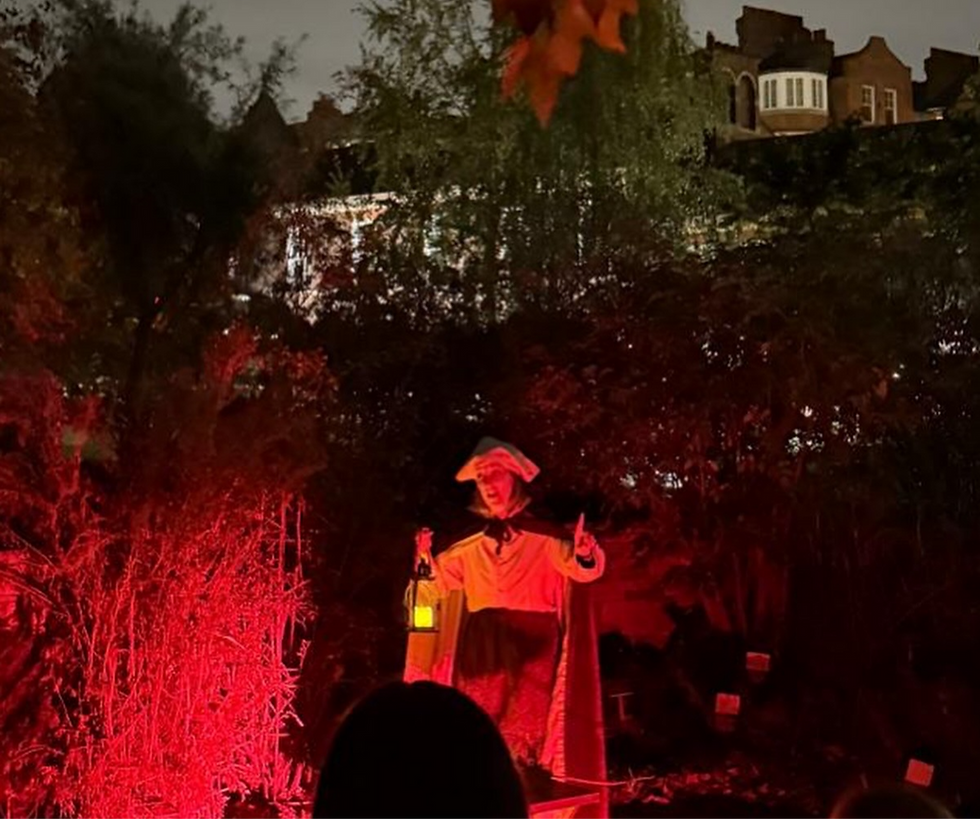
If you liked this and would like to learn more about the witch trials, book a ticket to my witch tour Hex and the City. This case particularly puts me in mind of a similar one that took place in London in 1615. I talk all about that one on my tour Magic Mystics and Martyrs. Both tours are running throughout the month.

Kyteler's Inn, Kilkenny, today.

Comments