

Herstory: Delarivier Manley - The woman of wit who didn’t give a s***!

A portrait believed to be of Delarivier Manley or Aphra Behn. Artist unknown, Bing images.
I had never heard of Delarivier “Delia” Manley. But she was a 17th/18th century controversial author, playwright and political pamphleteer that was named one of “The fair triumvirate of wit” - the three most influential female writers of the period, alongside Aphra Behn and Eliza Haywood. She was one of the first women to make a living from writing, and one of the reasons for her incredible success was her ability to weaponise her own scandalous private life - which was no less incendiary than her writings! She was truly a woman of wit who, to put it frankly, didnt ‘give a s***’ (!)
So this month we are deep-diving into the life of the fascinating and bad-ass Ms Manley. I’ll call her ‘Delia’ in this blog for ease.
Bigamy!
We can’t be sure of Delia’s early life because our only knowledge of it is based on a half-fictionalised autobiography, but most sources agree she was born around 1666 in Jersey to an army officer father. She lost her mother when young, and she and her siblings were then put into the care of their cousin when her Father died in 1687. Their cousin, MP John Manley, was about a decade older than Delia and already married but this didnt stop him bigamously marrying the ravishing young Delia. In 1691, they had a son.
In times of heightened misogyny and rigid gender expectations, bigamy was hugely scandalous and of course Delia’s participation in it, even if she were the one seduced (and not even the one originally married!) meant that her reputation was somewhat tarnished. But did she care? It doesnt seem so. In fact, it seems she decided she didnt have enough scandal in her life and decided to leave her husband and live with Barbara Villiers; the one time favoured mistress of Charles II! Barbara must’ve been exposed to all kinds of shocking things during her time in the Merry Monarch’s court, and yet Delia took it too far even for her. After 6 months she was thrown out of the Villiers household for ‘flirting’ with Barbara’s son!!

Barbara Villiers, att. to John Greenhill (1670)
Not one to be deterred, however, it seems Delia thrived on the drama - quite literally - as she then embarked on her playwright career. She started writing sexual comedies that seemed to be ‘inspired’ by her own experiences - stories of adulterous spouses and the treacherous concupiscence of men in power. She received a lot of mocking and ridicule for doing so. Writing such blatantly unwholesome content, as a woman, was pretty subversive. Nevertheless, her plays were staged at major theatres such as Theatre Royal Drury Lane.
Satire and Scandal!
But it was really her political satire that cemented her reputation. She published a roman a clef novel in 1709 caricaturing the Whig government. The New Atalantis placed the politicians on the fabled paradise island. In the novel, she mocked and exposed their extra-marital affairs and corrupt natures. It was hugely popular, unsurprisingly (!) and therefore, very dangerous.
Her book created such a brouhaha that she was arrested and put on trial for seditious libel. But the case was eventually dropped because, of course, she said it was all a work of fiction and, as the old Hollywood disclaimer goes, “…Any resemblance to actual persons, living or dead, or actual events… is purely coincidental.” Also, it would be rather embarrassing for those offended to attempt to prove that Delia had been telling their stories, - because that would’ve obviously exposed them as true!
So Delia ended up in a rather fun and enviable position as a writer. She had a tacit agreement with the powers that be that she would write only fiction, and yet everyone knew who and what she was referring to! She wrote several more books on the same themes as a result. Her work was even translated into French and German.
L: satirical print of The Tories and whigs 1832 Artist: CDG, R: The Duke of Marlborough, John Churchill- one of the subjects of Delia's ridicule.
In 1710 the Tories won the election, and Delia, having made enemies of the Whigs, saw her opportunity. She collaborated with Johnathan Swift, no less, on pro-Tory pamphlets and took over from him as editor of the Examiner newspaper in 1714. This was a profitable time for Delia when her career was at its peak, and she was in the employ of the Prime Minister.
But politics and power are shifty bedfellows. When George I came to the throne that same year, the Tory government collapsed and so did Delia’s status as political attack dog-in chief. It must’ve seemed to her that poverty and ignominy beckoned because she wrote a begging letter to her former patron and boss, ex-PM Robert Harley, lamenting:
“I have nothing but a starveling scene before me, Lord Marlborough* and all his accomplices justly enraged against me…”
* More about him later…
Then things seem to get worse as notorious Whig hack Charles Gildon, who had made his name publishing sensationalised biographies of notable figures; and enemies of numerous others including Johnathan Swift and Daniel Defoe; threatened to write a defamatory biography of Delia. Delia met with him and they made an agreement that she would write her own semi-fictional autobiography within a certain time span. This resulting book was called The Adventures of Rivella, published anonymously in 1714 , and told her story through the titular fictional female character.
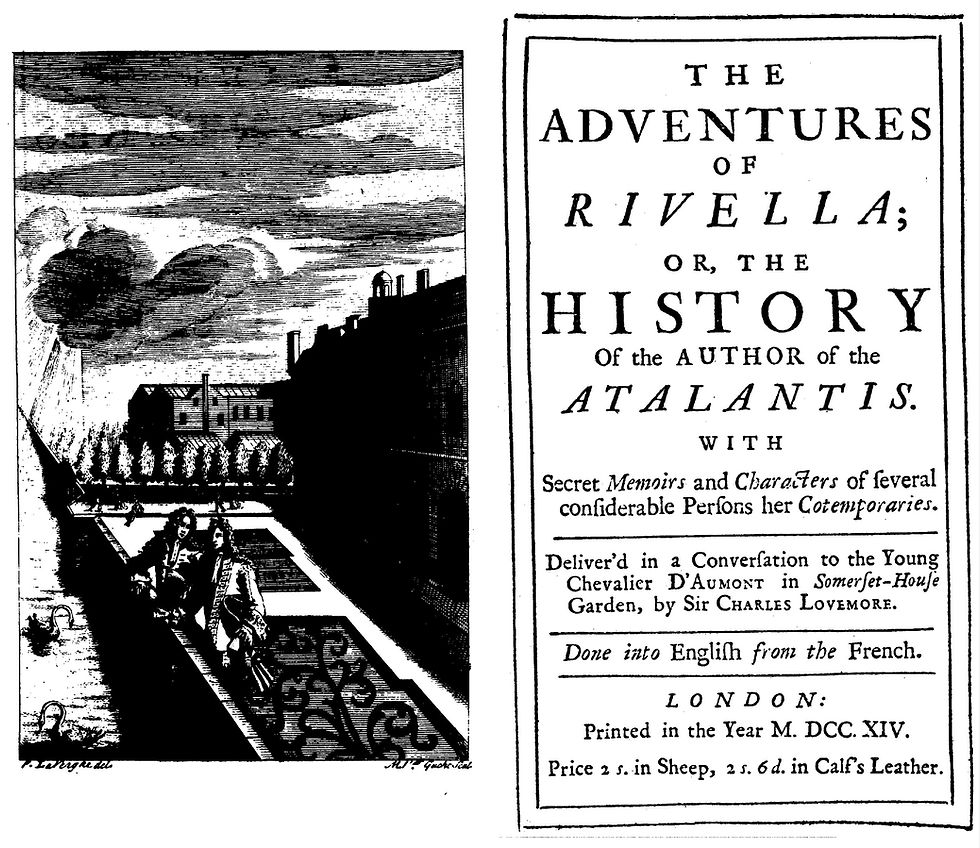
Manley's autobiography 1714 (wikipedia)
Revenge in writing...
The novel is an early feminist masterpiece in many ways. Not only does Delia recount her life events including her arrest and trial for libel, but also her chequered love life and bigamous marriage. She also uses the novel as a vehicle to scrutinise attitudes towards female writers in England during the eighteenth century, and the distinction between sexual abstinence and moral virtue.
Cleverly, Delia, ever aware of the rapidly changing nature of the political climate, shifts her political opinion by the end of the book to one of a more moderate nature so that she might find greater favour with whoever ended up in power later on. This proved to pay off - her play Lucius was produced by a Whig!
While she may have tempered her stance outwardly for sheer survival, Delia made sure to channel her rage against those in power with her final novellas. The Power of Love in Seven Novels (1720) depicted female characters exacting violent revenge against the men that betrayed them.
Delia died in 1724 in Lambeth and is buried at the Church of St Benet at Paul’s Wharf. Her legacy was ‘revisioned’ during the 18th Century with many male commentators branding her as too scandalous to ever be read. This narrative seems to have continued into the early 20th Century, with figures no less than PM Winston Churchill himself describing Delia as
“a peddler of ‘the lying inventions of a prurient and filthy-minded underworld… [it is regrettable that she] cannot be swept back into the cesspool from which she should never have crawled” (!!)

Winston Churchill by Yousef Karsh (Wikipedia)
Why is Winnie so triggered? Well, it’s kinda personal. In her New Atalantis, Delia made fun of many politicians, including John Churchill, 1st Duke of Marlborough, ancestor of Winston. Delia said among other things that the Duke had begun his career in the bed of royal mistresses. He later also gained a reputation as a somewhat failed military commander and Winston wrote his biography in an attempt to restore his reputation.
Thankfully, in more recent years female historians and academics have appraised Delia as a proto-feminist and helped to reconstruct her legacy as one of this country’s most important women writers.
For me, she’s definitely an early feminist icon. She was savvy, quick-witted and had sexual autonomy at a time where women generally didn’t and couldn’t. As usual, HIStory has, until recently, dismissed her at best and maligned her at worst. I dont think she would have been at all surprised at this, given that she weaponised her knowledge of unfair sexual and gender power dynamics to her advantage, and to great effect, during her career. In her autobiography is this quote about the female lead:
‘If she had been a Man, she had been without Fault: But the Charter of that Sex being much more confined than ours, what is not a Crime in Men is scandalous and unpardonable in Woman.’
I also love that she railed against the moral corruption of those in power, something that resonates so much with us all today! Delia was a powerhouse that deserves to be more widely known.


Comments