
HERSTORY: Sarah Baartman
- Herstorical Tours
- Dec 16, 2025
- 7 min read
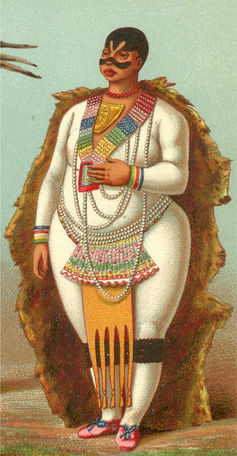
Caricature of Sarah, 1811. (Wikipedia)
I remember reading about Sarah Baartman ‘the Hottentot Venus’ some years ago, and being appalled at this very stark example of colonial racist and sexist exploitation. In an increasingly fascist, racist climate, her story is more relevant than ever. So here she is - my last herstory of the year and hopefully, some food for thought.
Stolen from Africa….
Sarah Baartman was born around 1789 in the Dutch Cape Colony of what is now South Africa. She was Khoikhoi (Hottentots- name given by Dutch), a member of an indigenous African tribe. Her birth name is lost but was believed to have been Ssehura - she was given the name Saartjie Baartman by the Dutch, anglicised later as Sarah.
Tragedy struck Sarah’s life young. Her mother died when she was a toddler. Not long after this her father was killed by rival Sarah Baartbushmen. So, orphaned, she worked and lived on Dutch farms and later moved to Cape Town to support herself as a washer woman and wet nurse for a ‘free black’ (formally enslaved African or person of enslaved decent) called Hendrik Cesars.
She had a relationship with a drummer around this time, and had a child who died in infancy. (It is not known how many children Sarah had throughout her life, but she was believed to have possibly had more than one.)
It was her employer, Cesars, who betrayed her first. He introduced her to a Scottish military surgeon at the city hospital called Alexander Dunlop. There was money to be had in ‘exhibiting’ exotic animal and human specimens to Europeans, and Dunlop operated a dubious but lucrative side hustle in the exporting of these specimens to circus and freak shows.
Now it’s unclear whether Baartman was forced abroad, or whether she was persuaded. The more palatable version of the story is that Dunlop told Baartman she would make money from exhibiting herself abroad, but she refused, unless Cesars went too. So, in 1810, the three of them set sail for England. The less savoury version is that she was simply ‘press-ganged’ into it by one or both men. Either way, poor Sarah’s troubles had only just started. She was just 21.

Caricature, 1810 (Wikipedia)
"The Hottentot Venus"
Upon her arrival in London, Baartman, Cesars and Dunlop took up lodgings in St James and she was immediately exhibited at the “Egyptian Room” of Thomas Hope in Cavendish Square. She was labelled “The Hottentot Venus” and was also regarded as particularly exotic because of her body shape which was unknown to Northern Europe at the time. Some African women of the indigenous Khoisan tribes have a body type known as steatopygia; characterised by large protruding buttocks and thighs. These attributes made Sarah not only sexually titillating to her European audiences but an object of scientific interest too, in much the same way as an exotic animal. Viewers paid to see her, and would be allowed to ‘measure’ her attributes whilst she sang and danced for them, often scantily clad. If they paid extra, they could even touch and grope her.
Freak shows were well established in northern Europe during this period, and The ‘Hottentot’ inclusion was used to further cement racist and colonial ideas of white, European racial superiority over other ethnic groups. She was often marketed as the "missing link between man and beast”.
But Sarah arrived in England just three years after the abolition of the slave trade, and her highly publicised exhibition caused uproar. Protestors campaigned for her release and the African Association - an abolitionist society - took the matter to court. They wanted to prove that Baartman was being held and displayed against her will. Cesars claimed she wasn't, and that she had to a right to earn a living the same as any contemporary ‘freak’ (he cited the Irish giant Charles Byrne in comparison). Baartman gave a statement in which she said she had consented to be exhibited, that she was not being abused in any way, and that she understood she was guaranteed half the profits of her exhibition. She also said she did not want to return to Africa. So the case was dismissed.
We can never know whether Sarah was expressing her truth in court or whether, once again, she was being coerced or threatened. But after the court case, she became even more famous and toured England and Ireland. She was officially baptised and named ‘Sarah Baartman’ in Manchester in 1811.

French caricature around 1812 - note the Euro-centric depiction of her skin and features!(Wikipedia)
The ‘Missing link’
But then things take a darker turn. She was taken to France and sold to an animal trainer (!) called Jean Riaux, who had a somewhat murky past. She was then exhibited at the Palais Royale in Paris for 15 months, and toured around wealthy people’s houses for private parties. The conditions she was kept in in Paris were woeful and akin to slavery. She was often exhibited caged with an iron collar around her neck, and was freely given to scientists and naturalists to examine.
French naturalists at this time were keen to prove their theories of ‘sexual primitivism’. They used Sarah’s body to show that black women had ‘larger genitals’ than white women, and therefore were more inclined to sexual depravity and lasciviousness; further cementing black women’s inferior status as ‘closer to beasts’. Conversely, 19th century feminine ideals were encapsulated by the silent, fragile, pale and fainting white woman. Sarah’s labia was observed to be ‘more elongated’ than most. You can only imagine what kind of humiliation and pain she went through in these investigations.
After Napoleon’s defeat France went into a depression which resulted in smaller audiences for Sarah. And that meant her funds dwindled. It is unknown how she supported herself in Paris after this, but prostitution is one possibility.

Illustration from Vol 2: Natural History of Mammals based on casts taken from her body posthumously. (1819)
On 29 December 1815 at the tender age of just 26, she died, penniless in Paris. Only five years after she first set sail from Africa. It is unknown what she died of, but most likely infectious smallpox, pneumonia or syphilis. Or maybe even a combination of more than one disease. It wasn’t unknown for indigenous people brought to Europe to die quickly once exposed to foreign diseases to which they had no immunity. Couple that with her poverty, and her death is not a huge surprise.
But she wasn't even allowed to rest undefiled in death. Her corpse was dissected by French anatomists and her brain, genitalia and skeleton were preserved for scientific curiosity. Her body was also cast and displayed at the Natural History Museum in Angers. European scientists continued to use Baartman’s remains to prove that Africans were genetically closer to apes than white Europeans. The naturalist Georges Cuvier described her ‘vivacity’ as ‘monkey-like’ and her ears like those of an ‘orangutan’.
In 1937 Baartman’s remains were relocated to the Musee de l’Homme and weren’t fully removed until 1976, as tastes began to change, and the women’s movements complained that displaying Baartman in that manner was degrading to women.
In 1994, Nelson Mandela, President of South Africa, requested that France return Baartman’s remains and after much legal wrangling, she was finally repatriated to her homeland in 2002, more than 200 years after her birth. She was buried in the Gamtoos Valley, where she was born.
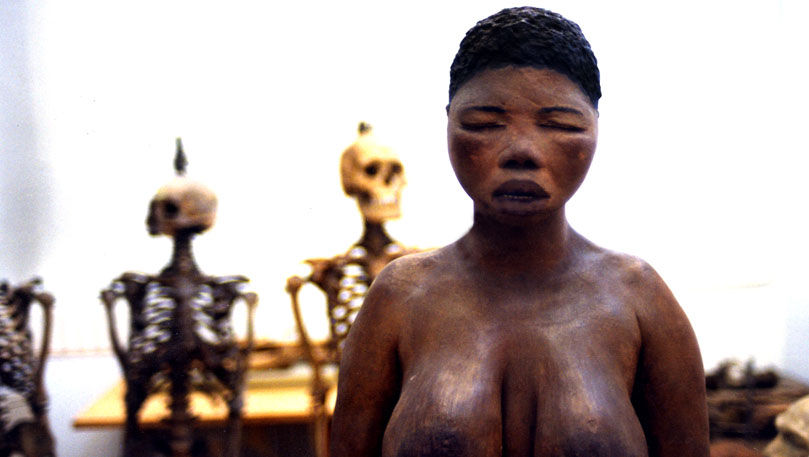
The cast of Sarah's body made after her death, and on display in Musee De L'Homme until 1976.
Sarah Baartman wasnt the only Khoekhoe to be taken from her homeland and exhibited in Europe. Throughout the 19th century there are several known examples of ‘Hottentot Venuses’ as well as men and children.
But she was the first. The first to be ‘displayed’ and used as an object for the projection of European colonial fantasies and ideologies. Her body in life and in death was constantly prodded, poked, manhandled and gawped at. She wasn’t treated as a human being- but a body. Even the name given to her by her dutch employers when she was orphaned translates as “savage servant’
President Mbeki presided over her repatriation funeral in 2002 and said:
“The story of Sarah Baartman is the story of the African people. It is the story of the loss of our ancient freedom ... it is the story of our reduction to the state of objects who could be owned, used and discarded by others.”
But she was more than just an embodiment of exploitation and fetishisation. She was a woman who’d experienced love, loss and the myriad of human experiences and emotions in her short life. She was clever and talented. She was described by Georges Cuvier, who met her in life (and later helped dissect her corpse) as:
“An intelligent woman with an excellent memory, particularly for faces. In addition to her native tongue, she spoke fluent Dutch, passable English, and a smattering of French... She was charming, pretty…adept at playing the Jew’s Harp… She could dance according to the traditions of her country, and had a lively personality”
(Memoires du Museum d'Histoire Naturelle in 1817)
Reading this, I feel incredibly sad. Because here we have a glimpse of the fleshed out, beautiful and complex human being that Sarah Baartman no doubt was; rather than the grotesque objectified caricature that she has become notorious for.

Baartman's grave and memorial in Gamtoos Valley, Africa.
Sarah’s legacy lives on. Her name has been given to districts, university buildings and a women’s refuge in South Africa. Some black feminists have claimed her as an icon of female beauty that resists the ideals of white mainstream standards. We can see this at work today with many influencers leveraging the stereotypically fetishised ‘black woman booty’ to make money. Even non-black women are doing it too - Kim Kardashian is the most famous example of this. This trend has found its way into plastic surgery and body modification trends. The BBL is the fastest growing cosmetic procedure in the UK and USA.
On the one hand you could argue that this is empowering for women (black and white) who are going to be fetishised and commodified on their looks anyway. At least they are taking ownership and making money from it themselves! On the other hand, promoting and continuing this legacy of fetishisation - so rooted in racist colonial violence - is surely harmful to all women in the long term. Not to mention cultural appropriation of black phenotypes, when white women do it!

Kim Kardashian, 2014 Paper Magazine (Jean Paul Goude)
I think the greatest irony of all is that while Sarah’s appearance was so mocked and reviled during her lifetime, anthropological evidence is now proving that the steatopygic body type that she had was much more widespread in ancient times than originally thought, and likely common throughout Europe. This is based on the survival of paleolithic sculptures of women found in northern Europe bearing striking resemblances to this body shape. The Venus of Willendorf is a famous example.

Venus of Willendorf (Wikipedia)
In 2015 Sarah Baartman’s gravesite was vandalised with white paint in a racially-motivated attack. 10 years later, we are seeing the rise of white nationalism and worrying revivals of old misogynistic and racist ideas that I thought we’d long since buried. This is all further proof that herstories like Sarah’s cannot be forgotten.


Comments